
Fraunhofer IFAM develops continuous 3D printing for mass production
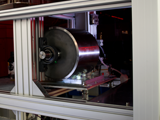

Continuous manufacture using the layer-by-layer principle for synthetic materials / Source: Fraunhofer IFAM/Thorsten Müller
Three-dimensional printing of polymer, metal or ceramic components is an additive manufacturing technology and enables the manufacture of individual and complex products for a variety of applications. Up to now, this manufacturing process has been a batch process and has required costly maintenance. Sponsored by the Volkswagen Foundation, scientists at the Fraunhofer Institute for Manufacturing Technology and Advanced Materials IFAM have developed a new production line, which facilitates a continuous and automated operation for liquid synthetic materials. The first components for the consumer sector have already been manufactured.
Powder-based continuous procedures already exist. However, the manufacturing principle cannot be transferred to liquid materials as they are used in the stereolithography process. During conventional stereolithography, selected areas of each layer are cured by radiation of UV light. This process is repeated layer by layer until the corresponding number of layers for the construction of the components has been completed. The elements are subsequently removed from the installation space, which is then set up again. This is a complex procedure which currently stands as an obstacle to mass production and also demands highly qualified staff.
The newly developed process uses the technology of continuous photopolymerisation based on the digital light processing system for the layer-by-layer manufacture of components. The significant difference compared with the usual production systems for additive manufacturing is that this new approach uses a rotating cylinder as the substrate and the flat platform is simply omitted. The lower part of this cylinder is submerged in a liquid polymer in the process and is illuminated by multiple light sources at an exactly defined and increasing range. This is necessary in order that the polymer can selectively be cured on the surface of the cylinder in different areas at various stages. As the cylinder gradually rotates, a three-dimensional component is built-up layer by layer on the submerged part of the cylinder. The manufactured components on the top of the cylinder can automatically be detached from the surface. The substrate surface is then ready again and the process can fully proceed.
Continuous manufacture is a great advantage particularly in view of the use of resources, as complete components constantly leave the production line and therefore operations are stabilised and thus improved. Up to now, the production cycle times of the traditional additive manufacturing procedures have been incomparable with conventional production lines of mass production. The approach of the Fraunhofer IFAM researchers is directed towards cost-effective individual mass production and will significantly improve the economic efficiency of the additive manufacturing technique.
Aktuelle Onlineartikel
-

19. 02. 2026 Biobasierte Fasern mit gutem Flammschutz
-

19. 02. 2026 Beton als CO₂-Senke
-

18. 02. 2026 Biobasierter Hochleistungskunststoff für die Elektroindustrie
-
18. 02. 2026 Laufzeitrekord und erste Stromerzeugung mit kompressorloser Wasserstoffgasturbine
-
17. 02. 2026 Blick durch die Röntgenbrille –Alterungsprozesse in Natrium-Zink-Salzschmelzbatterien entschlüsselt
-

28. 01. 2026 Wolfram: Dual-Use als Waffe im Rohstoffkrieg