
Cost-effective manufacturing of large-volume components with combined SLM and casting method
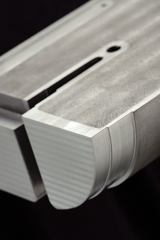

Tool cavity of tool steel made with SLM and filled with grey cast iron / Source: Fraunhofer ILT
In the past, selective laser melting (SLM) technology has been cost effective only for manufacturing components with relatively small volumes. In an innovative breakthrough that combines SLM with casting, now the Fraunhofer Institute for Laser Technology ILT has developed a cost-effective method for manufacturing solid, large-volume components using SLM.

Mold insert, made using the combined method of Selective Laser Melting and casting / Source: Fraunhofer ILT
Injection moulding is used to make the majority of plastic components. With additive manufacturing techniques such as SLM, it is possible to integrate complex conformal cooling channels into the tool inserts required for injection moulding. These channels allow the tool mould to be heated up during the injection process, and the melt to cool down quickly and evenly – resulting in rapid, distortion-free manufacturing. However, the manufacture of large-volume tool inserts using SLM is very cost-intensive, because the main production costs are volume-dependent.
To tackle this problem, scientists from Fraunhofer ILT have teamed up with the Foundry Institute at RWTH Aachen University and partners from industry in a bid to combine SLM and casting methods. In the “GenCast” project, which is funded by the German Federal Ministry of Education and Research as part of the Central Innovation Program SME (or ZIM in German), the project partners have worked together to build up the requisite process understanding and developed the process chain for the combined method.
The idea behind combining the two methods is to manufacture the shell of the tool insert from hot work steels (1.2343 or 1.2709) using SLM. During this process, cooling channels with complex geometries are still integrated in the exact places where they are needed to heat or cool the component. The shell built up using this technique serves as a casting mould, which is rapidly and cost-effectively filled with grey cast iron (e.g. GJL-200) or highly thermal conductive copper in a subsequent casting process. This cuts production times by up to 80% compared to components made using SLM alone. The bigger a component is, the more the advantages of this combined method come into play. It can be used cost-effectively from part sizes of only half a litre upward.
Aktuelle Onlineartikel
-
11. 05. 2026 Fluorfreie Trockenbeschichtung für leistungsfähige Batterien
-
11. 05. 2026 Laserdirektplattieren senkt Taktzeit und Kosten für dicke Metallbeschichtungen
-
27. 04. 2026 Warum kommt es zu Kurzschlüssen in Festkörper-Batterien?
-
27. 04. 2026 Neuer internationaler Masterstudiengang „Battery Technologies“ startet zum Wintersemester 2026/27
-
27. 04. 2026 Nanofiltration – Wasser wirksam von Glyphosat befreien
-

22. 04. 2026 ZVO-Oberflächentage 2026 erstmals in Karlsruhe: Jetzt anmelden!