
Reliable joining of high-strength steels using a laser hybrid welding process
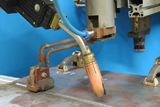

Experimental setup of the laser-GMA hybrid welding process with an inductive coil for preheating / source: LZH
Laser-gas metal arc (GMA) hybrid welding is fast, good for deep welding, and can be used to bridge large gaps. However, for thicker high-strength, fine-grain structural steels, hot cracks and undesired hardness levels can occur in the welding seam. For this reason, in an interdisciplinary project scientists at the Laser Zentrum Hannover e.V. (LZH) and the Leibniz Universität Hannover (LUH) have developed a hybrid welding system with inductive preheating. This process can be used for reliable, high-quality, single-layer welding of high-strength, fine-grain structural steels up to a thickness of 20 mm.

Single layer laser-GMA hybrid welding: Cross-section of a weld seam of 20 mm thick high-strength, fine-grain structural steel of the grade S690QL / source: LZH
In order to increase the weld seam quality for laser-GMA hybrid welding, the Joining and Cutting of Metals Group at the LZH has expanded the process to include integrated, inductive preheating. Directly before the welding process takes place, an induction coil brings energy into a targeted area of the welding seam. Thus, the steel is preheated to the desired temperature, without direct contact. The weld seams are less brittle, fracture strain values are better, and hot cracks can be avoided. With this process, steel sheets can be welded with a single-layer, and time and material can be significantly saved.
The process was developed for high-strength, fine-grain structural steels with yield strengths from 460 to 690 N/mm². Applications for the used grades S700MC, X70 and S690QL can be found in crane, pump, pipeline and bridge construction, and in offshore areas. With this process, depending on the sheet thickness, feed rates of 0.75 m/min to 2.5 m/min can be reached.
The basis for the project was close cooperation between the material and process technicians from the LZH, and the engineers from the civil engineering and electrical engineering fields at the LUH. While the engineers at the LZH experimented with welding processes, the Institute for Electrotechnology and the Institute for Steel Construction (both LUH) made simulations of the preheating process, respectively the welding process, and evaluated the welding seams.
The project DOVOR – High-performance welding of high-strength, fine-grained steels with high process reliability, using a hybrid welding process with integrated preheating – was financially supported by the German Federation of Industrial Research Associations "Otto von Guericke" e.V. (AiF) and the Research Association for Steel Application (FOSTA).
Aktuelle Onlineartikel
-
11. 05. 2026 Fluorfreie Trockenbeschichtung für leistungsfähige Batterien
-
11. 05. 2026 Laserdirektplattieren senkt Taktzeit und Kosten für dicke Metallbeschichtungen
-
27. 04. 2026 Warum kommt es zu Kurzschlüssen in Festkörper-Batterien?
-
27. 04. 2026 Neuer internationaler Masterstudiengang „Battery Technologies“ startet zum Wintersemester 2026/27
-
27. 04. 2026 Nanofiltration – Wasser wirksam von Glyphosat befreien
-

22. 04. 2026 ZVO-Oberflächentage 2026 erstmals in Karlsruhe: Jetzt anmelden!