


Electroless nickel coatings with between 4 % and 14 % phosphorus are widely used for corrosion protection. Such coatings provide varying degrees of corrosion protection and also possess varying degrees of internal stress. The age of the electrolyte can affect both these parameters. Using dialysis, the effects of electrolyte ageing can be minimised, thereby assuring a more consistent and better quality electroless nickel coating.
Korrosionsschutz mit stromlos abgeschiedenem Nickel – Eigenspannungen sind nicht zu unterschätzen!
Stromlos abgeschiedene Nickelschichten werden mit Phosphorgehalten zwischen etwa 4 % und etwa 14 % eingesetzt. Die Schichten besitzen unterschiedliche Korrosionsbeständigkeiten und unterschiedliche hohe innere Spannungen. Darüber hinaus macht sich auch das Alter der verwendeten Elektrolyte bemerkbar. Durch Einsatz der Dialyse lassen sich die Nachteile der Alterung verringern und die Qualität der Schichten verbessern.
1 Introduction – Basics
Electroless Nickel is a hard, silver coloured coating comprised of nickel alloyed with between 4 % and 14 % phosphorous. It is deposited by immersion of parts in a solution of nickel salts and reducing agents at a temperature of 90 °C. Although it has the appearance of an electroplated coating (e. g. like Hard Chrome), the process is purely chemical, so that deposition is evenly distributed over the part, including internal and external corners. For this reason, more and more parts for different usage are coated (Fig. 1).

Fig. 1: Industrial applications include automotive, aerospace, electronics, oil and gas, defence, optics, medical, food and drink, and engineering
It is aesthetically pleasing, and is often used for that property, as well as for its excellent polishing characteristics, making it suitable for creating highly reflective surfaces (optical applications). But most applications are for corrosion protection, where the nickel layer forms a barrier coating, isolating steel or aluminium substrates from corrosive atmospheres.
There are three types of Electroless Nickel:
- Low phosphorous (around 4 %) – Hard, good corrosion protection in alkaline environments, with lowest impact on fatigue
- Medium phosphorous (5 % to 9 %) – The most common; bright, with moderate corrosion and wear protection
- High phosphorous (10 % to 14 %) – Glass-like structure with the best corrosion protection, and non-magnetic.
In general, designers will usually specify the medium phosphorous variety. It is the easiest process to control, is the most economical and has the fastest deposition rate.
Additionally, Electroless Nickel is often combined with a self-lubricating polymer, either as part of the matrix (Poeton Apticote 450, Fig. 2) or integrated into the surface (Poeton Apticote 460, Fig. 3).
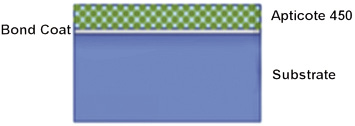
Fig. 2: Polymer as a part of the matrix in Apticote 450
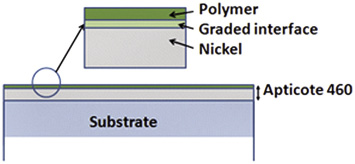
Fig. 3: Apticote 460 with polymer, integrated into the surface layer
2 Corrosion Protection
Unlike anodic coatings, such as cadmium or zinc, nickel will not provide any sacrificial protection for a steel substrate. It can provide complete protection only if the coating is free from voids, cracks or inclusions. Any path through the coating will lead to pitting corrosion at the substrate, with subsequent rust staining and lifting of the nickel.
2.1 Pitting corrosion
Pitting corrosion is usually caused in situations where a large cathode surface and a small anode surface are present. Examples of this include defects in surface coatings that are cathodic to the substrate, such as nickel, in chloride solutions. As the anode surface area is small, the penetration rate through the material is very high (Fig. 4).
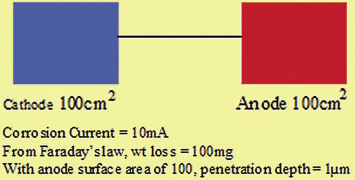

Fig. 4: Character of metal gives the corrosion current in case of defects in deposition
As a pit forms, mixing of the electrolyte becomes very difficult and the localised pH at the anode decreases, further increasing the corrosion rate. In the case of Electroless Nickel on steel, the same principle of a large cathode (the coating) coupling with a small anode (the steel) at the base of a defect will result in deep, local corrosion (Fig. 5).

Fig. 5: Corrosion situation in case of electroless nickel on steel
Porosity, cracks or defects in Electroless Nickel can be caused by:
- Porosity and defects in the substrate surface
- Inclusion of foreign debris at the surface, as well as intermetallics
- Coating is too thin
- Coating is tensile stressed, tending to open up any fine defects.
Whilst the first three of the above are a within the control of the processing company, using best practise and quality systems, the coating residual stress is a fundamental consequence of the process chemistry and thermodynamics.
3 Coating stress in Electroless Nickel
Figure 6 shows a set of results for salt mist corrosion endurance produced by Poeton for identical samples taken from eight different suppliers, using medium phosphorous Electroless Nickel (50 µm).

Fig. 6: Salt mist endurance of electroless nickel coatings
The variation between suppliers is wide, caused by different degrees of internal stress in the coatings, as explained below. Stress can be two-fold:
- Extrinsic – caused by differences in thermal expansion between the nickel and the substrate
- Intrinsic – generated as a consequence of the coating growth mechanism, which is in turn affected by the phosphorous content (Fig. 7), the age of the plating bath and the type of complexant used.
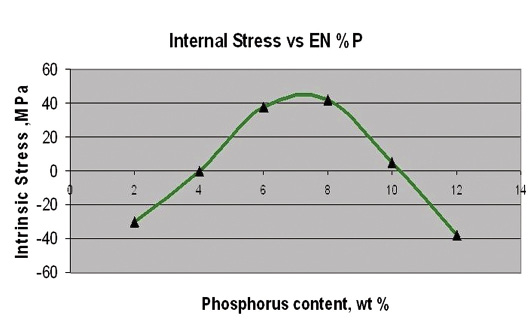
Fig. 7: Internal stress vs. phosphorous content of electroless nickel
Intrinsic stress is crucial to the corrosion protection, and needs to be compressive for best results. In terms of phosphorous content, internal stress is most tensile with the medium deposits.
Hence, high phosphorous deposits tend to give the better corrosion protection. Just as importantly, stress also varies with the age of the bath (Fig. 8). The process depends on the reduction of nickel sulphate by sodium hypophosphite, producing a reaction product as well as the plating metal. The reaction product must be complexed by lactic acid, and that builds steadily in concentration as the bath is used.

Fig. 8: Effect of bath contents
In traditional plating, as the nickel is consumed, periodic bulk additions are made to replenish the chemicals, but the reaction products continue increasing, until a point when the plating solution must be dumped and remade. That is usually after ‘six metal turnovers’ – meaning that the entire nickel content of the bath has been plated six times (via the replenishments).
As a consequence of the reaction products, the plating rate declines and the internal stress becomes increasingly tensile. This can be shown by plating thin foils, measuring the stress via the degree of flexure (Fig. 9).

Fig. 9: Internal stress vs. bath age
The consequence to corrosion protection is substantial, the result depending (as in Fig. 6 for the eight random suppliers) on the age of the bath in which the part was plated. Clearly, high phosphorous deposits are desired, but there is a trade-off with hardness and plating rate, which impacts on wear resistance and the process economics.
3.1 Using dialysis
An alternative to making periodic bulk additions is to adopt a computerised doping and dialysis unit (Fig. 10). The bath chemistry is continuously monitored, replenishing the chemicals as they are consumed, maintaining the optimum bath composition at all times, and preserving the highest plating rate.

Fig. 10: Effect of differing bath contents on coating stress
Additionally, the dialysis unit extracts the complexed reaction products as they are produced, thus eliminating the final cause of tensile stresses and allowing the bath to be used indefinitely. Such a bath, as is employed by Poeton, will produce coatings with consistently good corrosion protection performance (Fig. 11).

Fig. 11: Reducing differing bath contents by dialysis
4 Effect of thickness
Whilst a typical thickness of medium phosphorous electroless nickel is 25 µm, in orderto guarantee the required corrosion protection (500 h is often specified), thicker coatings are needed. For instance, the oil and gas sector now demands 75 µm thickness and also specifies that the age of the bath should not exceed three metal turnovers.
5 Grading the structure
Poeton employ a further (proprietary) technique to grade the structure of the nickel as it deposits, disrupting any potential corrosion paths through the coating. In this way, their Apticote 400D product can provide 1000 hours salt spray endurance (two small rust spots at the very end of the test).
Finally, by further sealing of the coatings surface with a sprayed, clear polymer, as with Apticote 460, the corrosion protection can extended beyond 1500 hours (Fig. 12).

Fig. 12: Endurance of different kinds of coatings
More information on Poeton and the Apticote range of engineering coatings at
- www.poeton.co.uk
DOI: 10.7395/2014/Stevens1