


In this project, the heat and flow transfer characteristics of a pin-fin heat exchanger were analyzed using a three dimensional finite element based numerical model. Simulations were conducted based on low Reynolds number and fully developed laminar airflow through an array of circular pin-fins. A computational fluid dynamic (CFD)-solution is established in order to study the flow characteristics and examine in detail the heat transfer process.
Strömung und Wärmeübertragung in einem 3D pin-fin channel
Untersucht wurden die Charakteristiken der Strömung und der Wärmeübertragung eines pin-fin Wärmetauschers unter Einsatz eines numerisch basierten dreidimensionalen Finite Elemente Modells. Die Simulationen wurden auf Basis von niedrigen Reynoldszahlen und vollständig entwickelter laminarer Strömung durch ein Feld kreisförmig angeordneter Stiftfinnen durchgeführt. Zur Untersuchung der Fließcharakteristik und des detaillierten Wärmeübergangs wurde eine CFD-Lösung herangezogen.
1 Introduction
Fluid flow associated with heat transfer in a pin-fin array has been a subject of a lot researches because of its significance in many industrial applications. To reduce fuel consumption, and pollutant emissions of a gas turbine manufacturers have generally increased the operating temperature, which leads to thermal and structural problems at the turbine blades. Therefore, a very efficient cooling system is necessary to keep the temperature below critical values. A coolant system design must adequately trade off increased heat transfer rates and minimal pressure loss. This can be obtained by staggered arrays of cylindrical pin-fins, that serve also as structural devices. Pin-fins with circular cross section are the most used and investigated because of their easier manufacturing. Such arrays enhance the heat transfer coefficient by promoting turbulence and flow acceleration and also improve the power output. An example of such a cooling system is shown in the Figure 1. The cooling system is situated at the trailing edge of the blade and is flowed around the air coming through the hole blade. In this report a numerical simulation of a pin-fin channel cooling system, found in turbine blades will be examined. The followed simulation, related to gas turbine blades can be used to any similar types of heat exchangers, which are used in a far range of industrial processes. This is possible, through some simplifications of the entire model.
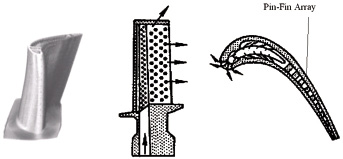
Fig. 1: Pin fin for simulation [1]
2 Geometry
To perform the numerical simulation the gas turbine blade is simplified and represented by a rectangular pin-fin channel. This channel contains 32 pins in a staggered arrangement (Fig. 2).

Fig. 2: Used arrangement of pins
For symmetry reasons, the geometry can be simplified, to the a easier geometry. This has a high positive effect on the calculation efficiency.
3 Precalculations
If the simulation should produce accurate and useful results, some precalculations should be elaborated to classify the fluid flow and adapt the simulation according to that.
The examining flow is determined by the Reynolds and March number:
Re = (r Umax D) / m = 5704.9
Ma = c / n = 0.012
Hence the Reynolds number is known we can find the flow pattern which surrounds the pins. A number of 5704 shows, that fully turbulent vortex shedding could occur. Thus the mesh behind the pins has to be sufficiently refined. Because von Karman Vortex could occur behind the pins, a unsteady simulation would be necessary. But a steady state calculation is sufficient for the global velocity and heat transfer. As the March number is <<1 the entire flow is incompressible.
4 Software
To get a accurate numerical result of the posed problem the simulation software ANSYS 14.5. was used. To handle the different steps of the simulation ANSYS Workbench is a great help. The calculation itself was examined with FLUENT in parallel mode with 4 cores.
5 Mesh
Solving a fluid flow problem numerical, the finite element method (FEM) is used in combination with special mathematical approaches of the flow pattern.
To be able to use the FEM, the entire domain has to be discretised in small elements which results in a mesh. In this case the inlet and outlet part are meshed with a uniform hexahedral mesh and the pin-fin part is meshed by tetrahedral elements to fit the round pins more accurate. The quality of the mesh plays a significant role in the accuracy and stability of the numerical computation, for that a very fine mesh was built with 280424 and 83430 nodes (Fig. 3).

Fig. 3: Used mesh for simulation
6 Numerical Model
As turbulence phenomena are expected behind the pins the numerical model has to contain a turbulence model for an accurate treatment. Performing a large eddy simulation (LES) or direct numerical simulation (DNS) would exceed the available resources, so the Reynolds-averaged Navier-Stokes (RANS) approach with a fitting turbulence model would be the best choice.
This approach will calculate the differential equation (Eq. <1> and <2>) for each node of the mesh. Of the various turbulence models the k-epsilon model is the most universal model, which is composed of the Equation <3> and <4>.
 <1>
<1>
 <2>
<2>
 <3>
<3>
 <4>
<4>
7 Results
After solving the Problem with aid of the numerical solver of the used software, various qualitative and quantitative results can be obtained (Fig. 4).

Fig. 4: Result of velocity contours, as get by numerical solver software
As expected, the air is accelerated between the pins, as the cross-sectional area decreases. The stagnation points at the front and at the back of each pin are clearly located where it is physically meaningful. In addition, the area behind each cylinder corresponds well to what is expected regarding the Reynolds number (5709).
The turbulence behind the pins can be made visible by using streamlines across the domain (Fig. 5).

Fig. 5: Turbulent streaming behind pin
By using Paraview the simplified geometry can be repatriate to the hole problem. In Figure 6, two different results are made visible. The pressure on the pins, according to the inlet velocity and the temperature distribution on the entire domain.
Further qualitative and quantitative results can be outlined by the obtained results. Through this simulation a clearer understanding of the flow pattern in a fin pin array can be undertaken. This project might not revolutionize the use and design of pin fin arrays but it should outline a insight into the procedure of a numerical flow simulation.
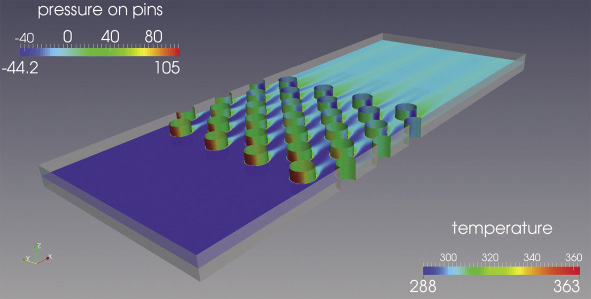
Fig. 6: Solution of simulation for whole area
Sources
[1] Jui Sheng Choo: Numerical analysis of the performance of staggered pin-fin micro heat exchangers; Naval postgraduated school Monterey, CA; Dec. 2003
Über den Autor
Lucas Engelhardt studiert Computational Science and Engineering (CSE) in Ulm im sechsten Semester. Während eines Erasmus-Auslandsaufenthaltes an der École Polytechnique Fédérale de Lausanne (Schweiz) belegte er den Master-Kurs Numerical Flow Simulation, in welchem eine Projektarbeit entstand. Der vorliegende Beitrag ist die Zusammenfassung der Arbeit.
Er unterstützt die WOMag im Bereich der Realisierung ihres Webauftritts.
DOI: 10.7395/2014/Engelhardt1
Die Universität Ulm (mit starker Beteiligung des Ulmer Zentrum für Wissenschaftliches Rechnen) und die Hochschule Ulm bieten einen neuen gemeinsamen Bachelorstudiengang an. Computational Science and Engineering (CSE) (deutsch: Rechnergestützte Methoden in Naturwissenschaft und Technik) verbindet Mathematik und Informatik mit einem breiten ingenieur- und naturwissenschaftlichen Fundament.Neue Erkenntnisse basieren heutzutage zunehmend auf Computersimulationen. Praktische Problemstellungen werden für die Simulation in mathematische Modelle übersetzt, mit denen virtuelle Experimente durchgeführt werden. Aus den Simulationsergebnissen lassen sich wiederum Rückschlüsse auf die Realität ableiten. Das Spektrum der Problemstellungen reicht von Fragen der Grundlagenforschung bis hin zu konkreten Aufgaben aus der Produktentwicklung.
Klassische Prüfungen sind teilweise abgeschafft und durch Projektarbeiten ersetzt. Für die Studenten soll der Studiengang dadurch studierbarer und attraktiver werden. Praktika und Abschlussarbeiten sollen verstärkt in Kooperation mit regionalen Unternehmen erfolgen, die einen zunehmenden Bedarf nach Simulationsingenieuren melden.
Die Einrichtung des Studiengangs wird von Mitteln der VolkswagenStiftung und der Stiftung Mercator im Rahmen der Initiative Bologna – Zukunft der Lehre gefördert.
- www.uni-ulm.de/mawi
Über den Studiengang CSE